Read article

If your roof is leaking, it does not automatically mean the tiles need replacing. On many pitched roofs, the tiles or slates can still be sound while the felt and battens underneath have deteriorated.
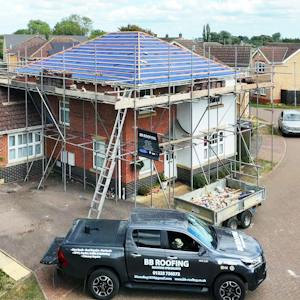
In the right circumstances, the sensible job is to carefully strip the roof covering, replace the underlay and battens, deal with any timber defects that are uncovered, then put the good tiles or slates back. That can preserve the appearance of the roof and avoid throwing away material that still has useful life left.
The tiles or slates are the main weathering layer, but they are not the whole roof. The felt — more accurately called the underlay on a modern roof — sits beneath the battens. It provides a second line of defence against wind-driven rain and snow that gets past the covering. Older roofs often have bituminous felt; modern re-roofing usually uses a membrane selected to suit the roof and its ventilation requirements.
The battens are the horizontal timbers that the tiles or slates are fixed to. They need to be strong, sound and correctly spaced. Current pitched-roof practice requires roofing battens to be graded for the purpose in accordance with BS 5534; ordinary timber is not an equivalent substitute.

We would not recommend re-felting a whole roof just because there is a damp patch. A cracked tile, failed valley, chimney flashing or another local defect may be all that needs attention. The first job is to establish where the water is actually getting in.
We look more closely at the felt and battens when we find:
One thing decades of roofing teaches you is not to diagnose a leak simply by looking above the mark on the ceiling. Water can travel along underlay, rafters and battens before it appears indoors. We pay particular attention to valleys, chimneys, eaves, roof junctions and penetrations before blaming the underlay.
Often, yes — but they have to be inspected rather than assumed to be good. We check for cracks, frost damage, heavy surface deterioration, damaged nibs and fixing holes, and whether matching replacements are available. With slate, the slate itself may still be sound even though old fixings have failed.
Historic England recommends retaining serviceable historic roof coverings where possible. That makes particular sense with good clay tiles and natural slate, where the existing material can be worth keeping for both performance and appearance.
There will normally be some wastage when a roof is stripped. A tile that looks sound in position can break when lifted, and weak pieces should not go back simply to increase the reuse percentage. The aim is to save the sound material, not every piece.
We see this on roofs around Cambridge, Ely and Newmarket, and further into Suffolk and Norfolk: the visible covering is not always the part that has failed first.
Ben was a fantastic communicator throughout the work on our roof. He helped identify the many problems and was great at explaining what was needed to rectify them and keep us dry and warm. The team worked incredibly hard to get the work done quickly and effectively. Price was fair and reasonable for the work required. Would reccomend BB Roofing to anyone.
5 stars Matthew Rudkin, Pitched Roofs Customer,
For a full job, the covering has to come off because the underlay sits underneath the battens. A typical job involves:
This is why “just replacing the felt” is still a substantial roofing job. Much of the work is in safely stripping and reinstating the roof.
It is also the best opportunity to inspect parts of the roof that are normally hidden. We would rather deal with a questionable timber while the roof is open than cover it up and create another problem later.
A modern membrane should not simply be substituted for old felt without considering how the roof deals with moisture.
BS 5250 covers condensation control in buildings, and the right combination of underlay, ventilation and insulation depends on the roof construction. A “breathable” membrane does not automatically mean that roof ventilation can be ignored.
Substantial re-roofing can also bring Building Regulations requirements into play, including the need to assess insulation. That is something to establish before work starts.

If there is one damaged area beneath a few broken tiles, a local repair may be sensible. If the felt is brittle across the roof and the battens are deteriorating, repeatedly patching individual leaks usually becomes poor value.
Equally, if the tiles themselves are nearing the end of their useful life, saving them can be false economy. Reusing tiles avoids buying a completely new covering, but stripping, sorting and relaying them still involves considerable labour. We look at both options before recommending one.
A drone is very useful for inspecting tiles, ridges, valleys, chimneys and other external details, but it cannot tell us everything about hidden felt and battens. On BB Roofing surveys we combine the external inspection with what can be seen from the loft and, where justified, closer investigation. Our site visit, drone inspection and written report are free.
If work is needed, the quotation should state clearly what is being retained, what is being replaced and what happens if hidden defects are found once the roof is stripped. BB Roofing takes no deposit, with payment on completion, and our work carries a 15-year guarantee.
Read article
Learn more
Learn more
15 year guarantee on everything we do
We've been in business over 50 years. If something goes wrong, we'll still be here to fix it.
The contact form needs JavaScript and reCAPTCHA. If it is unavailable, please call 01223 756572 or email enquiries@bbroof.co.uk.