Read article

A pitched roof repair should do more than stop the immediate leak. The important part is working out why the roof has failed, then repairing the covering, fixing or junction properly so the same problem does not return in the next spell of bad weather.
Some defects give you time to arrange a repair; others need attention quickly.
One thing we do not assume is that the wet patch inside the house is directly below the defect. Water can enter higher up the roof, run down a rafter, batten, underlay or flashing and appear several metres away.

We normally start by inspecting the whole affected roof area rather than concentrating only on the obvious damaged tile. Our drone inspection is useful here because it lets us examine ridges, valleys, verges, chimney junctions and individual coverings closely without guessing from ground level.
Where accessible, we also look from inside the roof. The pattern of staining can tell us a great deal about whether water is entering through the main covering, a junction or flashing, or whether the problem could actually be condensation.
We also look for the reason something has moved. A slipped tile may simply have been damaged, but several slipping in the same area can indicate failed fixings or battens. On an old slate roof, repeated slipping across a large area can indicate deteriorating nails rather than a series of unrelated broken slates. Continually replacing individual slates would then deal with the symptom rather than the underlying problem.
Interlocking concrete and clay tiles depend on the correct tile profile, interlock, lap and mechanical fixing. A replacement that looks approximately the right size is not necessarily suitable. We identify the tile and make sure the replacement sits correctly with the courses around it.
Plain clay or concrete tiles are double-lapped, so repairing one tile usually means carefully disturbing several surrounding tiles. Verge and abutment details also need the correct wider tiles and arrangement rather than small pieces being improvised to fill gaps.
Natural slate needs particularly careful handling. Slates vary in thickness and size and can become brittle with age. Replacement slates need the correct lap and secure fixing. Depending on the existing roof and its pitch, an individual replacement may be secured with an appropriate slate hook rather than trying to recreate a concealed nail fixing.
Low-pitched roofs demand extra care. As the pitch reduces, correct headlap and the suitability of the particular tile become increasingly important because rain is less quickly shed from the roof. Manufacturers specify minimum pitches and laps for individual products; these are not interchangeable simply because two tiles look similar.
Ben and his team were excellent in sorting our roof repairs what we needing sorting out, firstly they replaced our existing ridge tiles with a new dry ridge system then also made good of some new felt and Baton and tile work. Ben and his team were always on time polite throughout and most above all showed excellent workmanship I would certainly recommend them for anyone and I will only be using them from now on for any assistance needed for our roof.
5 stars Levi Hawkins, Pitched Roofs and Flat Roofs Customer,
For a slipped or cracked tile or slate, we remove enough surrounding covering to inspect the fixing, batten and underlay behind it. If those are sound, the covering can be replaced and correctly secured. If the batten is rotten or the underlay damaged, the repair needs to extend far enough to deal with that as well.
At ridges, hips and verges, loose mortar should not simply be pointed over if the bedding beneath it has failed. The affected section may need dismantling and rebuilding. Current pitched-roof practice also uses mechanical restraint: BS 5534 does not rely on mortar alone to resist wind uplift at ridges and hips.
Chimneys and wall junctions are more involved than applying sealant around the edge. Depending on the detail, the roof may use soakers, stepped flashings, cover flashings, an apron and a back gutter. We check which part is actually allowing water through. Lead also needs room to expand and contract; badly sized, restrained or previously patched leadwork can split again because the movement that caused the first failure has not been addressed.
Valleys deserve particular attention because they collect water from two roof slopes. Cracked valley material, displaced cut tiles or slates, debris and poor previous repairs can all restrict the water path. A lasting repair must restore both the waterproof lining and a clear route for water to drain.
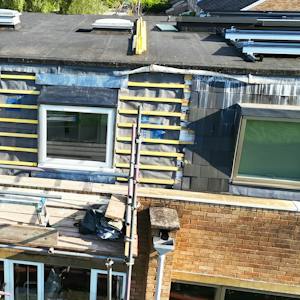
Where underlay or battens have failed locally, we normally expose enough roof to make a properly lapped repair from above. Simply sticking something over the underside of a torn membrane does not recreate the way the roof was designed to shed any water that gets beneath the tiles.

The visible part of a repair can be identical while the workmanship underneath is very different.
A quick repair might involve pushing a tile back into place without restoring its fixing, covering split lead with sealant, smearing mortar over a failing junction or replacing a tile without checking whether it has the correct lap. It may stop water temporarily but leave the original failure mechanism untouched.
A higher-quality repair considers the complete detail: the roof pitch, exposure, covering type, laps, fixings, battens, underlay and the route water takes off the roof. We also inspect the adjacent area while it is opened up. It makes little sense to replace one broken tile while leaving a cracked neighbour or a decayed section of batten that is likely to fail shortly afterwards.
The aim is not automatically to make the repair larger. In many cases a small, properly diagnosed repair is all that is required. The skill lies in knowing when the fault is genuinely isolated and when the visible damage is the first sign of a wider problem.
Read article
15 year guarantee on everything we do
We've been in business over 50 years. If something goes wrong, we'll still be here to fix it.
The contact form needs JavaScript and reCAPTCHA. If it is unavailable, please call 01223 756572 or email enquiries@bbroof.co.uk.