Read article

The age of your house can give useful clues about the roof problems most likely to develop, but it is only a starting point. We ask:
With more than 50 years in roofing, we have learnt that the most expensive mistakes often come from treating every roof of a certain age in the same way.
Older roofs can be remarkably durable, particularly when they are covered in good natural slate or traditional clay tiles. Age alone is not a reason to replace them. The parts that often deserve closer attention are the fixings and junctions.
Keep an eye on:
One common problem with older slate roofs is nail sickness. The slate itself may still be sound, but the old iron nails holding it can corrode. A few slipping slates may be repairable; slates slipping in different areas across the roof can indicate a more widespread fixing problem.
Do not assume that an uneven old roof is automatically unsafe. Older timber roofs often settle over time. What matters more is whether movement appears to be continuing, whether timbers are wet or decayed, or whether joints are opening.
Historic England also advises against replacing historic roof coverings unnecessarily where they remain serviceable.
A good repair should preserve sound material wherever practical. If the slates are still good but the fixings beneath them are failing, the right answer may be to carefully strip and relay the roof rather than replace everything with new material.

Inter-war houses often have hipped roofs, chimneys and tiled coverings with several mortar and lead details that need maintenance over time.
Keep an eye on:
A common mistake is waiting until water starts dripping through a ceiling.
By that stage, moisture may already have affected battens, felt, plaster or timber. Water can also travel along the roof structure before becoming visible indoors, so the position of the stain does not always tell you where the problem is.
If mortar around hips or ridges is breaking away, it is worth having it inspected before tiles become loose. A lasting repair involves removing unsound material and making the detail secure again, rather than simply applying a thin layer of new mortar over something that is already failing.
This is an age of house where the roof can look quite respectable from outside while problems are developing underneath. Many post-war homes were built with concrete tiles over timber battens and bituminous roofing felt. The tiles may still have years of life left even when the felt or battens have deteriorated.
Keep an eye on:
Do not worry about appearance alone. Concrete tiles naturally weather and discolour, and moss does not by itself mean the roof needs replacing. What matters is whether the tiles remain sound and secure, and what condition the roof is in beneath them.
This is something we pay particular attention to because replacing apparently old tiles can be unnecessary. Where the covering is still usable but the felt and battens have reached the end of their life, it may be possible to strip the roof, renew what has failed underneath and reuse suitable tiles.
Homes and garages from this period can also contain asbestos-cement materials. HSE guidance is clear that suspected asbestos should not be drilled, cut or broken without proper identification and precautions.
Very good job. Left the property spotless. Very good pricing. Would highly recommend.
5 stars Wesley Theobald, Roof Repairs Customer,
On roofs from this period, alterations made since the house was built can be as important as the original construction. Loft insulation may have been increased. Fascias and soffits may have been replaced. Roof windows, extensions, bathroom extractors, aerials or other equipment may have been added.
One issue to watch for is condensation in the loft.
Keep an eye on:
A wet loft does not always mean rain is getting through the roof.
Warm, moist air from the house can reach a cold roof space and condense if ventilation is inadequate. Extra loft insulation can sometimes make this worse if it blocks airflow at the eaves.
This is why diagnosis matters. Replacing tiles will not solve a condensation problem, just as adding more ventilation will not repair failed flashing.
NFRC guidance recommends dealing with roof-space condensation through appropriate ventilation and attention to the way moisture enters and moves through the roof space.
With a relatively young roof, widespread age-related failure should not normally be the first assumption.
Keep an eye on:
If tiles repeatedly come loose on a young roof, for example, that may point towards a fixing or installation issue rather than worn-out tiles.
The same applies to leaks. Repeatedly sealing the area where water appears indoors can disguise the symptom without finding the point where water is actually getting in.
On newer roofs especially, a good repair should identify why the detail has failed rather than simply adding another layer of sealant.

You do not need to call a roofer because a roof looks old. It is more useful to act when something has changed.
Keep an eye on:
Small defects are usually cheaper to deal with before water has had time to damage the materials underneath.
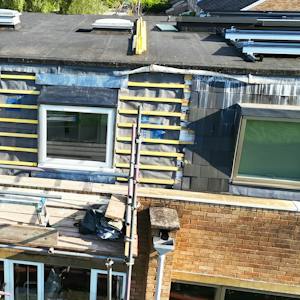
When we inspect a roof, we try to understand the whole problem rather than judging it from one photograph or one damp patch. That can mean looking at the roof covering, valleys, chimneys and junctions from outside, then checking the felt, battens, timbers and signs of water movement from inside.
Where useful, BB Roofing provides a free drone inspection and report so difficult areas can be checked safely and shown clearly to the homeowner.
The aim should always be to repair what has actually failed, retain what is still sound and avoid unnecessary work. For work we carry out, no deposit is required, payment is made on completion, and the work is covered by our 15-year guarantee.
Read article
Read article
15 year guarantee on everything we do
We've been in business over 50 years. If something goes wrong, we'll still be here to fix it.
The contact form needs JavaScript and reCAPTCHA. If it is unavailable, please call 01223 756572 or email enquiries@bbroof.co.uk.