Read article

If a roof has already been “fixed” once or twice and the same damp patch keeps coming back, don’t assume the only answer is a new roof.
Persistent leaks are often difficult because the obvious defect isn’t the real defect. A cracked tile gets changed. The chimney is repointed. Some flashing is sealed. Everything looks sensible, but the next spell of bad weather brings the water back.
At that point, the important job is diagnosis. Before replacing anything, we want to understand exactly when the problem happens, how the water could be travelling and what is different about this roof.
One of the first things we ask about a troublesome leak is not simply “where is it?” but “when does it happen?”
Different patterns point us in different directions:
This is why a quick look on a dry afternoon does not always reveal much. With awkward leaks, the circumstances are part of the evidence.
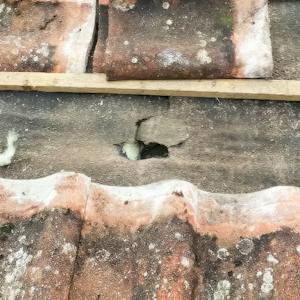
Water does not necessarily enter the roof directly above the stain on your ceiling. Once it gets beneath the covering it can run down an underlay, follow a rafter, travel along a batten or find its way to a fixing before finally dripping. We have seen problems where attention has repeatedly been focused on the tiles above the damp patch when the entry point was considerably further up the roof.
This becomes especially important around dormers, valleys, chimneys and extensions, where several different roof details meet.
Manufacturer guidance from Marley also recognises mechanisms such as wind-driven rain, capillary action, rainwater creep and water being forced through tile overlaps during severe conditions. A tiled roof can therefore look perfectly sound and still fail under one particular combination of wind and rain.
We’ve spent over 50 years looking at roofs, and one thing that experience teaches you is not to stop at the first plausible explanation.

A particularly awkward example is a pitched roof or extension meeting the wall of the main house. It is easy to blame the lead flashing because that is the visible weatherproofing detail. But rain can sometimes penetrate the masonry higher up, enter the wall cavity and travel down behind perfectly serviceable flashing. That is why cavity trays and weep holes are used at certain roof abutments. LABC and NHBC guidance both deal specifically with protecting these junctions.
We pay particular attention to this possibility where:
Putting more sealant around the flashing won’t cure water that is arriving from behind it.
Valleys carry a lot more water than an ordinary part of a roof because they receive runoff from two slopes. The difficult cases are valleys that aren’t obviously broken. They may remain dry through twenty ordinary showers and leak during one severe storm.
The problem can be a narrow section, poor detailing beneath the tiles, accumulated debris, an inadequate overlap or simply a roof arrangement that delivers more water into the valley than the detail can comfortably handle. The same principle applies where a large upper roof discharges onto a smaller low-pitched roof below.
Marley’s technical guidance specifically warns that low-pitched roofs and long valleys need careful consideration because water volumes increase during storm conditions.
This is the sort of defect where changing a few nearby tiles can appear to work simply because the next few rainfalls are less severe.
Was recommended by a work colleague as had a leak in porch, Ben and his team sorted it within a day and even replaced the damp plaster board excellent job many thanks you you x
5 stars Customer, Leak Investigation,
Leadwork lasts extremely well when it is detailed correctly, but it also expands and contracts as temperatures change.
If a piece has been made too large, fixed too rigidly or repeatedly patched without addressing the movement, tiny fatigue cracks can develop. Around a chimney, valley or complicated junction, that crack may be hidden beneath an overlap.
A smear of sealant can temporarily hide the symptom without correcting the reason the lead split in the first place.
When we inspect troublesome leadwork, we’re therefore interested in more than whether there is an obvious hole. We look at how the detail has been formed, where it is fixed, how the water is meant to leave it and whether the lead has been allowed to move.
Damp around a chimney breast often gets blamed on the flashing, but chimneys have several other ways of becoming wet.
Historic England and the Society for the Protection of Ancient Buildings both highlight problems including rain penetrating porous or deteriorated masonry, failed flaunching, water entering open flues, condensation inside disused flues and moisture held by salts left behind from years of combustion.
That means a roofer can replace perfectly good flashing and still leave the actual problem untouched.
On an older chimney we want to look at the whole stack:
The correct repair might be localised roof work, chimney work or improved ventilation rather than dismantling the surrounding roof.
Roof-space condensation is another reason repeated leak repairs can fail.
Warm, moist air from the house can reach a cold roof space and condense on underlay, timbers or fixings. The resulting drops can produce damp ceilings even though the roof covering isn’t letting rain through.
We become particularly suspicious when a problem began after insulation, reroofing or other work that changed the ventilation of the roof.
The National Federation of Roofing Contractors recommends dealing with condensation through properly designed roof ventilation rather than relying on improvised fixes. If condensation is the cause, replacing tiles will achieve nothing.
With a difficult leak, we don’t want to start by deciding what to replace. We want to reconstruct what the water is doing.
That normally means looking at:
Our free drone inspection is useful for getting a detailed view of areas that are difficult to see safely from ground level, and we provide a report so the findings can be considered properly. But a drone photograph is only one part of diagnosing a difficult leak. Sometimes the important clue is inside the loft; sometimes a small area needs opening up to see what is happening underneath.
After nearly 50 years in roofing, we’ve learnt that the expensive answer isn’t automatically the right answer. If the defect can be identified and repaired locally, there is no sense replacing a sound roof around it.
Where work is needed, BB Roofing doesn’t take an upfront deposit: payment is made on completion, and our work is backed by a 15-year guarantee.
Read article
Learn more
15 year guarantee on everything we do
We've been in business over 50 years. If something goes wrong, we'll still be here to fix it.
The contact form needs JavaScript and reCAPTCHA. If it is unavailable, please call 01223 756572 or email enquiries@bbroof.co.uk.